I have decided to give some honey back to the bees. I haven't taken any from them, but had a couple of quarts from the cut out back in June and finally decided that it is better to give to the bees than let sit around in my kitchen. I want to encourage the girls in Machado to draw out all the comb in the upper hive body and get strong enough to survive the winter. I haven't been real involved in their feeding and storing, preferring to leave them to their own devices rather than give them syrup and pollen to stimulate them into action. They won't take pollen at this point, and there is plenty around in the garden, so I will leave them to that, but I thought I might give them a few pounds of honey to keep them from repurposing the wax foundation on the outer frames. They take it eagerly, so I'll keep giving it until it has run out. Now I feel bad for having thrown away as much of it as I did (upwards of 10-15 pounds.)
A couple of days ago CJ was in the garden and got a bee in her bonnet. She called me as I was on my way to work to inform me that she was stung on the top of the head. I had to go home and remove the stinger because EJ was too scared and CJ couldn't see it. It was right on the crown of her head. I got the stinger out and applied some Denver's Sting Stop that a friend gave me after the last sting. For the record, I didn't have it until 36 hours after I was stung, so it was useless for me, but I applied it to CJ's head. Her reaction wasn't as great as mine, but neither was her reaction when she got stung between the eyes. She still felt the pain from the sting for several hours, so I don't know if the stuff works. I'd rather not coax a bee into stinging me just to find out, but we have it on hand now just in case.
It's hot these days, with temperatures in the mid 90s and humidity is higher as well. The girls in both colonies are working hard on their own AC and the higher temps and humidity make them a little more touchy. I was able to open the top cover of Machado yesterday afternoon and pour some honey on the inner cover without feeling threatened at all, but the flurry of activity right in and around the garden combined with the recent sting on CJ's head has chased her and the kids all into the house. I may be forced to relocate the bees if they continue to monopolize the yard.
Wednesday, June 25, 2008

Wednesday, June 18, 2008
Let the bees work
Last Tuesday I realized that I needed to flip the inner cover in Machado and thought, "what a perfect opportunity to test my relationship with the bees." How tough can it be? Remove the outer cover, flip the inner cover, replace the outer cover. Even with propolis, it's a 30 second chore, max.
Machado's girls are working on drawing out comb in the upper hive body and there were about 20 of them on or around the inner cover. I calmly and boldly removed the inner cover and was in the process of flipping it when I inadvertently swatted at a couple of the girls inspecting my left hand (which was holding the inner cover) and immediately felt their wrath. Two stings, one just where my wedding ring sits and one on the inside of my forearm, about 2 inches up from the wrist. I felt several other girls getting ready to sting and beat a hasty retreat to remove the stingers, don the gloves, and re-cover the hive. I got it closed up and for the first six hours or so after the stings had no problem. Then about 2am, I woke with my arm on fire. The delayed reaction began and it was pretty fierce (considering this is my first "real" sting in years.)
My entire left arm swelled and itched and burned for three days. No anaphylaxis, so that was good, but the localized reaction shows me that I have a ways to go before I become immune to bee venom. CJ wanted me to take pictures of my arm and post it here, but my pride barely lets me post the story of being stung. I guess we live and learn.
So I left the girls alone for a week. Yesterday I thought I would check on their progress at drawing out comb in the upper hive body and AFTER putting on all the protective gear and lighting my smoker, got into the hive to see what they've been up to. I noticed that they are eating the wax from the foundation on the outside frames, so I need to feed them in order to encourage them to make their own wax. Population is still high and they are working well. I wanted to be minimally invasive so I didn't pull any brood frames. I gave them some of the honey that I pulled from the colony removal when I got Shakespeare and will continue to feed them the honey in hopes that they will speed up their comb-making.
Shakespeare is a different story, probably because I have an observation window in the side of the hive. It certainly makes checking on them much easier. Although I have not seen Portia yet, she is definitely present and laying because yesterday I saw capped brood in new comb. These girls are doing exactly what bees do best. I only wish my own ineptitude hadn't set them back so much at the start. This colony was way too big for the top bar hive I had built for them and they sacrificed many of their drones (as well as several workers) because they had no space. They are working well and drawing out comb all over in the hive, so I'll definitely have a mess in the spring, but unless I come across a better idea, I'll let them build up and get ready for winter. If the colony makes it through my first year as a beekeeper, I'll improve their home for my benefit (and hopefully theirs.)
Machado's girls are working on drawing out comb in the upper hive body and there were about 20 of them on or around the inner cover. I calmly and boldly removed the inner cover and was in the process of flipping it when I inadvertently swatted at a couple of the girls inspecting my left hand (which was holding the inner cover) and immediately felt their wrath. Two stings, one just where my wedding ring sits and one on the inside of my forearm, about 2 inches up from the wrist. I felt several other girls getting ready to sting and beat a hasty retreat to remove the stingers, don the gloves, and re-cover the hive. I got it closed up and for the first six hours or so after the stings had no problem. Then about 2am, I woke with my arm on fire. The delayed reaction began and it was pretty fierce (considering this is my first "real" sting in years.)
My entire left arm swelled and itched and burned for three days. No anaphylaxis, so that was good, but the localized reaction shows me that I have a ways to go before I become immune to bee venom. CJ wanted me to take pictures of my arm and post it here, but my pride barely lets me post the story of being stung. I guess we live and learn.
So I left the girls alone for a week. Yesterday I thought I would check on their progress at drawing out comb in the upper hive body and AFTER putting on all the protective gear and lighting my smoker, got into the hive to see what they've been up to. I noticed that they are eating the wax from the foundation on the outside frames, so I need to feed them in order to encourage them to make their own wax. Population is still high and they are working well. I wanted to be minimally invasive so I didn't pull any brood frames. I gave them some of the honey that I pulled from the colony removal when I got Shakespeare and will continue to feed them the honey in hopes that they will speed up their comb-making.
Shakespeare is a different story, probably because I have an observation window in the side of the hive. It certainly makes checking on them much easier. Although I have not seen Portia yet, she is definitely present and laying because yesterday I saw capped brood in new comb. These girls are doing exactly what bees do best. I only wish my own ineptitude hadn't set them back so much at the start. This colony was way too big for the top bar hive I had built for them and they sacrificed many of their drones (as well as several workers) because they had no space. They are working well and drawing out comb all over in the hive, so I'll definitely have a mess in the spring, but unless I come across a better idea, I'll let them build up and get ready for winter. If the colony makes it through my first year as a beekeeper, I'll improve their home for my benefit (and hopefully theirs.)
Thursday, June 5, 2008
The photographer deserves hazard pay...
Sometimes I should be content to leave well enough alone, but that's just not part of my nature.
I got home from work this evening at about 5 and thought for some reason that it would be good to get into the hives and inspect them. Of course, beekeeping guidelines recommend you get into the hive in the middle of the day when most of the foragers are out of the hive, but I had to work today and figured 5 pm is still light enough for the majority of the bees to be out on their errands.
I also wanted a few pictures of the bees to examine them a little closer and make the blog a little more interesting, so I enlisted CJ's help. I was the lucky one because I got to wear the suit and veil.
After getting Machado open and finding Capitolina, CJ got closer to get video of new bees emerging from their cells when a bee got into her face/hair/personal space and...#!$*#&$! She got stung between the eyes.
Can you believe she actually stopped to photograph herself with the stinger still in her skin? She tweezed the stinger out (she swears she didn't hear me tell her to scrape it out) and then photographed the offending stinger.

I didn't immediately rush to her aid because I was still holding the frame with Capitolina on it and didn't particularly want to endanger her more than I did my dear wife, so I left CJ to fend for herself. (It's a good thing she loves me like she does.)
I did find some great things, though. Here's a closeup of worker brood. It looks pretty good, it's all brand new comb as you can tell by the white wax.
 I am happy to see good brood pattern on this frame. They all look like this. At first I was intrigued by the lines of empty cells, but realized that those cells are where the wire runs down the middle of the foundation. The other side of the frames are identical. Not surprisingly, the wire is crimped and where it protrudes into the foundation, the queen has determined that it is unacceptable for her precious eggs. I don't suppose I'd leave my children in an unsuitable nursery, so she must be a good mother...
 Capitolina is on this frame, can you find her? There are also brand new bees emerging from their cells on this frame. (This is what CJ was trying to video when she got stung.)
I was also into Shakespeare and the girls in that colony are quite a bit more aggressive. They have propolized all of the top bars together and have done a fine job drawing out several top bars of crooked comb and several bars of straight comb. Hmm. I am still not sure what I'll do about them. I still haven't seen Portia, but I can see larvae through the observation window, so I am assuming she's in there and laying. It is on old comb, though, so those eggs may have come with the colony from the cut out. Only time will tell.
Here are some pictures of the girls from the different hives.
 These are the girls from Shakespeare.
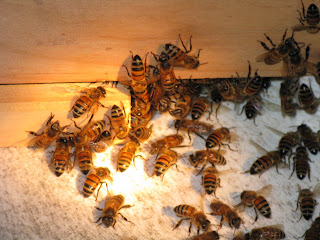 These are Machado's girls.
Can you tell any difference? It's difficult to see them this way, especially because you can't compare size, but I swear I can see the difference when I am working with them. Maybe I am just crazy...
I got home from work this evening at about 5 and thought for some reason that it would be good to get into the hives and inspect them. Of course, beekeeping guidelines recommend you get into the hive in the middle of the day when most of the foragers are out of the hive, but I had to work today and figured 5 pm is still light enough for the majority of the bees to be out on their errands.
I also wanted a few pictures of the bees to examine them a little closer and make the blog a little more interesting, so I enlisted CJ's help. I was the lucky one because I got to wear the suit and veil.
After getting Machado open and finding Capitolina, CJ got closer to get video of new bees emerging from their cells when a bee got into her face/hair/personal space and...#!$*#&$! She got stung between the eyes.

Can you believe she actually stopped to photograph herself with the stinger still in her skin? She tweezed the stinger out (she swears she didn't hear me tell her to scrape it out) and then photographed the offending stinger.

I didn't immediately rush to her aid because I was still holding the frame with Capitolina on it and didn't particularly want to endanger her more than I did my dear wife, so I left CJ to fend for herself. (It's a good thing she loves me like she does.)
I did find some great things, though.
 Here's a closeup of worker brood. It looks pretty good, it's all brand new comb as you can tell by the white wax.
 I am happy to see good brood pattern on this frame. They all look like this. At first I was intrigued by the lines of empty cells, but realized that those cells are where the wire runs down the middle of the foundation. The other side of the frames are identical. Not surprisingly, the wire is crimped and where it protrudes into the foundation, the queen has determined that it is unacceptable for her precious eggs. I don't suppose I'd leave my children in an unsuitable nursery, so she must be a good mother...
 Capitolina is on this frame, can you find her? There are also brand new bees emerging from their cells on this frame. (This is what CJ was trying to video when she got stung.)
I was also into Shakespeare and the girls in that colony are quite a bit more aggressive. They have propolized all of the top bars together and have done a fine job drawing out several top bars of crooked comb and several bars of straight comb. Hmm. I am still not sure what I'll do about them. I still haven't seen Portia, but I can see larvae through the observation window, so I am assuming she's in there and laying. It is on old comb, though, so those eggs may have come with the colony from the cut out. Only time will tell.
Here are some pictures of the girls from the different hives.
 These are the girls from Shakespeare.
 These are Machado's girls.
Can you tell any difference? It's difficult to see them this way, especially because you can't compare size, but I swear I can see the difference when I am working with them. Maybe I am just crazy...
Wednesday, June 4, 2008
A Tale of Two Colonies
With two colonies in the back yard, I don't want to be as prosaic as referring to them as the Langstroth and Top Bar colonies, so I am going to take a page from city bees and name them after literary greats.
Colony One, housed in a Langstroth hive, caught as a swarm between Killen and Florence, AL will from here on be known as Machado in honor of the father of Brazilian letters, Joaquim Maria Machado de Assis. Naturally, the queen of this colony will be Capitolina, or Capitu for short. A tragic female character from _Dom Casmurro_, arguably Machado's greatest novel.
Colony Two, housed in a homemade top bar hive, removed from a porch column in Huntsville, AL will from here on be known as Shakespeare for William Shakespeare, the great English playwright. The queen of this colony will be Portia, the strongest heroine in all of Shakespeare's works, and more particularly from _The Merchant of Venice_.
Of course, I have never seen Portia and it has been weeks since I have seen Capitu, but at least I now have something creative to call them.
Colony One, housed in a Langstroth hive, caught as a swarm between Killen and Florence, AL will from here on be known as Machado in honor of the father of Brazilian letters, Joaquim Maria Machado de Assis. Naturally, the queen of this colony will be Capitolina, or Capitu for short. A tragic female character from _Dom Casmurro_, arguably Machado's greatest novel.
Colony Two, housed in a homemade top bar hive, removed from a porch column in Huntsville, AL will from here on be known as Shakespeare for William Shakespeare, the great English playwright. The queen of this colony will be Portia, the strongest heroine in all of Shakespeare's works, and more particularly from _The Merchant of Venice_.
Of course, I have never seen Portia and it has been weeks since I have seen Capitu, but at least I now have something creative to call them.
Don't fear the stinger
Nobody likes to get stung. Let's face it, it's just not fun. Sure, there are people who swear by bee venom and say that it cures everything from arthritis to high blood pressure. Having been stung three times in the last month, I know enough to say that I am not ready to just let bees sting me at will, nor am I desirous to encourage such bee-havior. I am still seeking for that symbiotic relationship between myself and the bees that will result in all of us living our lives and helping each other out.
I feel I have done a noble deed with both colonies, recovering a swarm and removing a feral colony, both in danger (perhaps not imminent) of being destroyed by the humans whose property they were occupying. I have given them a place to live and am encouraging them to do what they do best, so I expect the bees to recognize this peace offering on my part and respond accordingly...
Now that the top bar hive (I have to come up with a better name for these colonies) is established, I can approach it during the day and not have the sentry bees buzzing me and attempting to run me out of their territory. I still struggle with the proximity of workers at times. I let the kids hold drones that have been booted from their hives and I have coaxed a worker onto my hand, but I am still not comfortable doing that. I know that worker bees will not sting unless they are threatened, but to retrain myself to NOT duck and cover when a bee gets close enough to my head when I am in the bee yard is still a bit of a challenge.
I read someone's theory that bees can sense fear and may be enticed to sting preemptively. I'm not sure of that, but it seems to make sense. As I get more comfortable around the bees, they are more comfortable around me and I can take more liberties with them without worrying about getting stung.
It's going to happen. I know I will have other stings, but I really want to get over the gut reflex to wave (or even thrash) at the curious or well meaning worker bee who happens to get too close to my personal space.
I feel I have done a noble deed with both colonies, recovering a swarm and removing a feral colony, both in danger (perhaps not imminent) of being destroyed by the humans whose property they were occupying. I have given them a place to live and am encouraging them to do what they do best, so I expect the bees to recognize this peace offering on my part and respond accordingly...
Now that the top bar hive (I have to come up with a better name for these colonies) is established, I can approach it during the day and not have the sentry bees buzzing me and attempting to run me out of their territory. I still struggle with the proximity of workers at times. I let the kids hold drones that have been booted from their hives and I have coaxed a worker onto my hand, but I am still not comfortable doing that. I know that worker bees will not sting unless they are threatened, but to retrain myself to NOT duck and cover when a bee gets close enough to my head when I am in the bee yard is still a bit of a challenge.
I read someone's theory that bees can sense fear and may be enticed to sting preemptively. I'm not sure of that, but it seems to make sense. As I get more comfortable around the bees, they are more comfortable around me and I can take more liberties with them without worrying about getting stung.
It's going to happen. I know I will have other stings, but I really want to get over the gut reflex to wave (or even thrash) at the curious or well meaning worker bee who happens to get too close to my personal space.
A worm update
Although they are not nearly so exciting to watch as the bees, the worms are also performing a very important task in our home. We started out with 3 lbs of worms in the vermicomposter and every morning for a week we would get up and find that another 50-100 had "wandered" out of their carefully constructed bedding and onto the garage floor where they dried up and died. We initially thought that 3000 worms in one little bin was too many, so we quickly put another bin on the top, but that didn't help too much. Soon we had worms crawling out of two bins instead of just one.
I had to do a little extra research on suicidal worms and found that in the initial days of starting a vermicomposter, unless you have a well established bed of compost, worms get stressed and tend to vacate the premises rather than adjust to their new home. I had to go out to the garden and grab a couple of shovelfuls of composted topsoil to mix into their bedding. Once that was in there, the worms have been quite content to stay in the bin. I also left them under a fluorescent spotlight for about 48 hours to deter them from seeking greener pastures outside of the bin. Red Wigglers hate the light, so the spotlight was like my very own anti worm-wander security system.
I am sure it was a combination of the topsoil and the nightlight that got them to stay, but now they are eating the kitchen scraps and making castings. We have been stockpiling kitchen scraps for several days and the worms have their work cut out for them for a while. Hopefully we can get caught up and achieve some sort of balance between the waste we generate and what the worms can process.
I had to do a little extra research on suicidal worms and found that in the initial days of starting a vermicomposter, unless you have a well established bed of compost, worms get stressed and tend to vacate the premises rather than adjust to their new home. I had to go out to the garden and grab a couple of shovelfuls of composted topsoil to mix into their bedding. Once that was in there, the worms have been quite content to stay in the bin. I also left them under a fluorescent spotlight for about 48 hours to deter them from seeking greener pastures outside of the bin. Red Wigglers hate the light, so the spotlight was like my very own anti worm-wander security system.
I am sure it was a combination of the topsoil and the nightlight that got them to stay, but now they are eating the kitchen scraps and making castings. We have been stockpiling kitchen scraps for several days and the worms have their work cut out for them for a while. Hopefully we can get caught up and achieve some sort of balance between the waste we generate and what the worms can process.
Monday, June 2, 2008
Why beekeeping is so cool

Okay, so WH is holding a drone (which cannot sting) but the fact that he is involved and excited about such things makes it totally worthwhile.

Queenright!!!!
It seems my fears about being queenless were unfounded. I was into the hives again today after 9 days of leaving them alone and found things working well. The last time I was into the langstroth hive, I saw that they needed another hive body (if only to fill with honey) because they had drawn comb out on eight of ten frames. I hadn't seen any brood comb, nor had I seen the queen during that examination, so I was worried I was going to lose the colony. I finally got another hive body and was able to open the hive and check things out before adding the new body to the hive. I had thrown some feral brood comb into the hive in the hopes that they would raise up a new queen, but found no queen cells or new brood on those combs today. As I pulled out a couple of the middle frames, I saw them about 3/4 covered with capped worker brood. I even saw a young lady chewing her way out of her cell!!! That's really quite cool. It just means that nature is considerably smarter than I am and all of my worrying was for nothing. I added the new frame to the top and have high hopes that this colony will be strong enough to really get out there and make some honey this year!!!
The top bar hive has turned into quite a mess. Without a frame to attach the feral brood to, the heat from the sun and my own ineptitude have resulted in an M.C. Escher-esque hive, with comb running in every direction, twisted and turning, connected on the bottom, sides and top of the hive in different places. I cleaned out some of the old comb and straightened out some of the comb that could be straightened and stood up, but for the most part, I am going to have to leave these girls alone to their devices for the rest of the season. I found no queen with the colony because I cannot get several of the top bars out of the hive because of the mess of comb I have. They're still working and nursing the brood that they have from their feral colony and I didn't find any queen cells, so I am going to give them the benefit of the doubt and hope for the best. I'll reopen the hive in a week or two and try and clean out what burr comb I can, but I think I'd rather let this colony straighten itself out this summer and I'll do what I can to winterize them in the fall. If they can get strong enough and draw out comb on the top bars (which they are doing,) I should be able to get in and clean out the old, unattached comb once the queen has stopped laying for the season. In the meantime, I'll let them do their thing...
One observation I have to make, these colonies are VERY different. The bees in the first colony seem to be milder, smaller, and have more yellow on their bodies. The bees in the second colony are darker and look to be about 10-25% larger than the others. They are also a fair bit more aggressive. I am not confident enough with them right now to open the hive without my smoker and suit in place. They are a little more used to having me around so I can at least visit my garden without having them buzz me away.
The top bar hive has turned into quite a mess. Without a frame to attach the feral brood to, the heat from the sun and my own ineptitude have resulted in an M.C. Escher-esque hive, with comb running in every direction, twisted and turning, connected on the bottom, sides and top of the hive in different places. I cleaned out some of the old comb and straightened out some of the comb that could be straightened and stood up, but for the most part, I am going to have to leave these girls alone to their devices for the rest of the season. I found no queen with the colony because I cannot get several of the top bars out of the hive because of the mess of comb I have. They're still working and nursing the brood that they have from their feral colony and I didn't find any queen cells, so I am going to give them the benefit of the doubt and hope for the best. I'll reopen the hive in a week or two and try and clean out what burr comb I can, but I think I'd rather let this colony straighten itself out this summer and I'll do what I can to winterize them in the fall. If they can get strong enough and draw out comb on the top bars (which they are doing,) I should be able to get in and clean out the old, unattached comb once the queen has stopped laying for the season. In the meantime, I'll let them do their thing...
One observation I have to make, these colonies are VERY different. The bees in the first colony seem to be milder, smaller, and have more yellow on their bodies. The bees in the second colony are darker and look to be about 10-25% larger than the others. They are also a fair bit more aggressive. I am not confident enough with them right now to open the hive without my smoker and suit in place. They are a little more used to having me around so I can at least visit my garden without having them buzz me away.
Saturday, May 24, 2008
Removing a Colony
Friday, May 23, 2008
Be careful the things you wish for, you just might get them...
My brief news spot last week landed me in something I am not sure I was ready for. I got a call a day after my big news story from a lady in Huntsville who had a colony of bees take up residence in the column on their front porch. This was my big chance to move into the beekeeping big leagues, so I had to take the chance. Besides, if I didn't get the bees out, they would have poisoned them. What's a self-respecting hobby beekeeper to do?
So I built a bee vacuum, did a lot of reading (props to Basic Beekeeping for the detailed description of how to) and thought the best way to learn is to do.
Friday morning at 0700 I cut into a column of bees. The ten foot column was about 8" diameter at the top and about 12" at the bottom. Comb ran from the top to about 3 feet from the bottom and there were bees everywhere. They told me that the swarm had only been there about a month, but they were a strong colony. I pulled a lot of brood comb out of that colony along with a bunch of honeycomb. The honey tastes great, but because it wasn't all capped, I will remove it from the comb, collect the wax, and put the honey back out for the bees. Waste not, want not, right?
I built a top bar beehive to house the new colony because I am interested in comparing both types of hives and right now I am not sure if they have accepted their new home or not. They are inside, outside and all over it, so I may have bitten off a bit more than I could chew. I did throw brood comb in both the top bar hive and the langstroth in the hopes that if I don't have a queen in either colony (I never saw the queen from the colony I removed from the column) I will hopefully be lucky and let the bees raise up a new one.
CJ is tired of bees right now. Preparing for the colony removal has consumed almost my entire week from Tuesday night until Saturday and she's just a little jealous of my attention to the 100,000 ladies I have brought home to roost. I think I will enter a hands-off beekeeping stage right now. I have an observation window built into the side of the top bar hive and I'll check it nightly, but beyond that, I think I'll give the bees a week or more to just settle in.
I will pray a little for their success. My ineptitude and lack of skill may just prove too much at this point, but I will certainly hope that the bees are more tenacious than that. I mean, they've survived far worse than this, right?
For the record, I got stung on the forehead after all of the major work was done. I was cleaning up the honey, comb, sawdust, bee, tool, etc. mess after the removal and one stray worker bee figured (rightly) that I was responsible for the destruction of her home and she exacted her revenge by stinging me. That makes three stings that I have felt: two on the day I collected my first swarm and one yesterday. None of them have been all that bad, but they certainly aren't pleasant. Hopefully I will gain some immunity to the venom and the swelling (which isn't bad right now) will be even less. What I really don't like is the itching for the days after...
Be careful the things you wish for, you just might get them...
My brief news spot last week landed me in something I am not sure I was ready for. I got a call a day after my big news story from a lady in Huntsville who had a colony of bees take up residence in the column on their front porch. This was my big chance to move into the beekeeping big leagues, so I had to take the chance. Besides, if I didn't get the bees out, they would have poisoned them. What's a self-respecting hobby beekeeper to do?
So I built a bee vacuum, did a lot of reading (props to Basic Beekeeping for the detailed description of how to) and thought the best way to learn is to do.
Friday morning at 0700 I cut into a column of bees. The ten foot column was about 8" diameter at the top and about 12" at the bottom. Comb ran from the top to about 3 feet from the bottom and there were bees everywhere. They told me that the swarm had only been there about a month, but they were a strong colony. I pulled a lot of brood comb out of that colony along with a bunch of honeycomb. The honey tastes great, but because it wasn't all capped, I will remove it from the comb, collect the wax, and put the honey back out for the bees. Waste not, want not, right?
I built a top bar beehive to house the new colony because I am interested in comparing both types of hives and right now I am not sure if they have accepted their new home or not. They are inside, outside and all over it, so I may have bitten off a bit more than I could chew. I did throw brood comb in both the top bar hive and the langstroth in the hopes that if I don't have a queen in either colony (I never saw the queen from the colony I removed from the column) I will hopefully be lucky and let the bees raise up a new one.
CJ is tired of bees right now. Preparing for the colony removal has consumed almost my entire week from Tuesday night until Saturday and she's just a little jealous of my attention to the 100,000 ladies I have brought home to roost. I think I will enter a hands-off beekeeping stage right now. I have an observation window built into the side of the top bar hive and I'll check it nightly, but beyond that, I think I'll give the bees a week or more to just settle in.
I will pray a little for their success. My ineptitude and lack of skill may just prove too much at this point, but I will certainly hope that the bees are more tenacious than that. I mean, they've survived far worse than this, right?
For the record, I got stung on the forehead after all of the major work was done. I was cleaning up the honey, comb, sawdust, bee, tool, etc. mess after the removal and one stray worker bee figured (rightly) that I was responsible for the destruction of her home and she exacted her revenge by stinging me. That makes three stings that I have felt: two on the day I collected my first swarm and one yesterday. None of them have been all that bad, but they certainly aren't pleasant. Hopefully I will gain some immunity to the venom and the swelling (which isn't bad right now) will be even less. What I really don't like is the itching for the days after...
Bad news (I think)
Thursday, May 22, 2008
I was into my hive for a little beeswax and a weekly examination and try as I might, I could not locate the queen. Now this is not usually a problem as long as there is evidence of her presence: brood cells in various stages of progress, etc. etc. I have eight frames of comb drawn out and filled with honey. No brood, no eggs, just several thousand worker bees doing the only thing they know what to do: draw out comb and store nectar.
I have photographic evidence of her presence one week ago, but she hadn't laid any eggs and I was worried only slightly then. Who knows why she's gone... Either she was an old queen on her last swarm or a virgin queen who had taken off on a mating flight and never made it back to the hive. Perhaps it was something in between, but any way I add it up, one colony minus one queen equals no colony or bees in a few short weeks.
I have to find a queen and fast, or I'm going to be quite upset at this failure.
I was into my hive for a little beeswax and a weekly examination and try as I might, I could not locate the queen. Now this is not usually a problem as long as there is evidence of her presence: brood cells in various stages of progress, etc. etc. I have eight frames of comb drawn out and filled with honey. No brood, no eggs, just several thousand worker bees doing the only thing they know what to do: draw out comb and store nectar.
I have photographic evidence of her presence one week ago, but she hadn't laid any eggs and I was worried only slightly then. Who knows why she's gone... Either she was an old queen on her last swarm or a virgin queen who had taken off on a mating flight and never made it back to the hive. Perhaps it was something in between, but any way I add it up, one colony minus one queen equals no colony or bees in a few short weeks.
I have to find a queen and fast, or I'm going to be quite upset at this failure.
Tuesday, May 20, 2008
Bees and now Worms!?!?!
Since we arrived in Alabama, I find that my outlook on life has changed dramatically. I am extremely concerned about the amount of waste that goes out of our house and into the garbage truck. Our city recycles, which is very nice, but there's still a bunch of garbage that we'd like to eliminate from the landfill, so we decided to build a couple of composters...
I found simple plans for a hot composter (for yard clippings and such) by fastening together five shipping pallets. It's free once you find the pallets and it will eventually turn your yard clippings into nutrient-rich compost. It's uninspiring and less than romantic, but it's clean and will boost the fertility of my Alabama red clay garden.
The problem with an open back-yard composting bin is that it cannot do kitchen scraps. Those attract pests and that's just not cool. But we eat a lot of fruits and vegetables and often have peelings and cores and other kitchen waste that we wanted to dispose of differently, so we bought a vermicomposter. Yes, that is fancy talk for worm farm.

Strange, yes, but necessary I think. CJ surprised me with this for our tenth wedding anniversary. (Who knew that the tenth anniversary was the worm anniversary?)
Regardless of what the occasion is, I am almost as excited about the worms as I am the bees. It's going to be nice to see the bees pollinate the garden that grows in my homemade worm-processed compost.
I found simple plans for a hot composter (for yard clippings and such) by fastening together five shipping pallets. It's free once you find the pallets and it will eventually turn your yard clippings into nutrient-rich compost. It's uninspiring and less than romantic, but it's clean and will boost the fertility of my Alabama red clay garden.
The problem with an open back-yard composting bin is that it cannot do kitchen scraps. Those attract pests and that's just not cool. But we eat a lot of fruits and vegetables and often have peelings and cores and other kitchen waste that we wanted to dispose of differently, so we bought a vermicomposter. Yes, that is fancy talk for worm farm.

Strange, yes, but necessary I think. CJ surprised me with this for our tenth wedding anniversary. (Who knew that the tenth anniversary was the worm anniversary?)
Regardless of what the occasion is, I am almost as excited about the worms as I am the bees. It's going to be nice to see the bees pollinate the garden that grows in my homemade worm-processed compost.
Monday, May 19, 2008
So, why bees?
In an earlier post, I stated how I got interested, but why? Here's the philosophy (which is bound to change somewhat) behind my decision to keep bees.
When I was a kid, there were honeybees everywhere. I would step on a bee and have a sting on the foot almost every summer. I hated that, but I also felt fascinated with the fuzzy little creatures. I knew that they didn't care about me as long as I wasn't stepping on them, so I got to the point where I would pet them as they went from flower to flower in my front yard.
Then they just weren't there any more.
Maybe I grew up and stopped looking for them, but when I wanted to see bees, I rarely did. I read about CCD (Colony Collapse Disorder) and the imminent destruction of the world's honeybee population. I was concerned, sort of.
As I became more aware of the world around me, I realized that there's a lot happening out there that I am missing out on. There's so much to be learned if I am just willing to put in the time. Besides, if I can keep bees, there are sure to be great benefits from it, right?
I enjoy working outdoors. I have a small garden plot and keep dozens of houseplants. If I could live in a conservatory, I would. CJ is not ready for that yet. Bees perform 80% of the pollination on food plants consumed by the human race, so I figured, "If I am going to grow my own food, I may as well get the pollinators to help me." So I began looking into keeping bees.
I want to have my own honey too.
Right now, my modest bee colony is in a single, deep, 10-frame Langstroth hive that I will probably expand into a 2 deep hive body with 2 or 3 medium supers. I hope this colony will get strong enough to fill that baby right up. Still, I don't know how "hands-on" I want to be with these little marvels. I'd really rather give them a space to live and let them do their thing like they have for millennia. I'm not real excited yet about exploiting the girls for their honey and making a fortune selling bee products. I just want a garden that thrives, a few pounds of honey at the end of the year, and an opportunity to teach my children about life and nature.
I am looking at building a top-bar hive in case I decide to split or catch another swarm. It would be nice to compare the hives' success side by side.
So there it is in a nutshell. This may become an obsession after a while, or it may wane. I am not the type to neglect my bees even if this passion wanes, but I can be quite content with one or two colonies buzzing around my yard. If it grows, I already have offers of out-yards where I can keep colonies. Who knows, maybe it will turn into something more.
When I was a kid, there were honeybees everywhere. I would step on a bee and have a sting on the foot almost every summer. I hated that, but I also felt fascinated with the fuzzy little creatures. I knew that they didn't care about me as long as I wasn't stepping on them, so I got to the point where I would pet them as they went from flower to flower in my front yard.
Then they just weren't there any more.
Maybe I grew up and stopped looking for them, but when I wanted to see bees, I rarely did. I read about CCD (Colony Collapse Disorder) and the imminent destruction of the world's honeybee population. I was concerned, sort of.
As I became more aware of the world around me, I realized that there's a lot happening out there that I am missing out on. There's so much to be learned if I am just willing to put in the time. Besides, if I can keep bees, there are sure to be great benefits from it, right?
I enjoy working outdoors. I have a small garden plot and keep dozens of houseplants. If I could live in a conservatory, I would. CJ is not ready for that yet. Bees perform 80% of the pollination on food plants consumed by the human race, so I figured, "If I am going to grow my own food, I may as well get the pollinators to help me." So I began looking into keeping bees.
I want to have my own honey too.
Right now, my modest bee colony is in a single, deep, 10-frame Langstroth hive that I will probably expand into a 2 deep hive body with 2 or 3 medium supers. I hope this colony will get strong enough to fill that baby right up. Still, I don't know how "hands-on" I want to be with these little marvels. I'd really rather give them a space to live and let them do their thing like they have for millennia. I'm not real excited yet about exploiting the girls for their honey and making a fortune selling bee products. I just want a garden that thrives, a few pounds of honey at the end of the year, and an opportunity to teach my children about life and nature.
I am looking at building a top-bar hive in case I decide to split or catch another swarm. It would be nice to compare the hives' success side by side.
So there it is in a nutshell. This may become an obsession after a while, or it may wane. I am not the type to neglect my bees even if this passion wanes, but I can be quite content with one or two colonies buzzing around my yard. If it grows, I already have offers of out-yards where I can keep colonies. Who knows, maybe it will turn into something more.
Sunday, May 18, 2008
My bees made the news!
It helps to have the local news reporter living in your apartment...
Click Here to Watch
Click Here to Watch
My first Hive Examination
Saturday, May 17, 2008.
The bees have been working in their hive for 4 days and I just HAD to see what they were up to. I needed to see if the queen was alive and well and just what was going on inside that hive. So I donned the gear, lit the smoker and opened the hive. CJ took photos of my first foray into beekeeping, so I'll add them here and comment on them as I go.

Lighting the smoker

Examining a frame.

The bees are drawing out the comb and there's a QUEEN there!!! She's very beautiful. Can you find her?
I will let them work for another week and hopefully will have some brood in there. I think I saw some eggs, but it's way too early for brood and I don't really have experience identifying them at this early stage. I saw several bees carrying pollen on their back legs, saw several cells with pollen in them, several more with clear liquid (water? nectar?) and hopefully a few eggs, but it's too early for me to discern a pattern in the queen's laying (or if she's laying at all.) She definitely hasn't got any attending bees that I had hoped to see surrounding her, but they are a small colony and I don't expect them to be too established after only four days.
The bees have been working in their hive for 4 days and I just HAD to see what they were up to. I needed to see if the queen was alive and well and just what was going on inside that hive. So I donned the gear, lit the smoker and opened the hive. CJ took photos of my first foray into beekeeping, so I'll add them here and comment on them as I go.

Lighting the smoker

Examining a frame.

The bees are drawing out the comb and there's a QUEEN there!!! She's very beautiful. Can you find her?
I will let them work for another week and hopefully will have some brood in there. I think I saw some eggs, but it's way too early for brood and I don't really have experience identifying them at this early stage. I saw several bees carrying pollen on their back legs, saw several cells with pollen in them, several more with clear liquid (water? nectar?) and hopefully a few eggs, but it's too early for me to discern a pattern in the queen's laying (or if she's laying at all.) She definitely hasn't got any attending bees that I had hoped to see surrounding her, but they are a small colony and I don't expect them to be too established after only four days.
Ian gets stung.
Wednesday, 14 May, 2008.
I got home from work this afternoon and had to check on my new pets. The weather was nice, so I expected the bees to be out doing what they do best. As I approached the hive (from the back) I could see that there were several bees on the entrance board, several more taking flight and an equal number returning from their foraging adventures. It looked like all was right with the world.
My five-year old idolizes me and when I am home, he is not far from me. It's great to have a fan club, even if you have to raise them yourself... but I digress.
Ian and I were sitting on the lawn about 15 feet in front of the hive and down a slight slope, so we were at eye level with the entrance. I was watching the flurry of activity at the entrance and explaining the finer points of the action to my son when he reached up to swat a bee from his hair. This action resulted in a sting on his pinky-finger and the offending bee still floundering in his hair. It took no time before he was crying and cursing the bees, but only a couple of seconds before two or three other bees were responding to the sacrifice of their sister. Did you know that once a bee stings, the chemical they release with their dying sacrifice signals to the other bees that they need to sting as well? I waved them away, but realized that it was safest to pick up my son and run. We made it away without any further casualties, but I hadn't had the bees even 24 hours and already my son had been stung. It's fine if I get stung. I almost expect it to happen, but if my kids get stung, I begin to lose face at home.
One freezy-pop and some gentle explaining later and my five-year old had decided that bees weren't all that bad and he was willing to give them another chance. Now he wants me to buy him his own bee suit...
I got home from work this afternoon and had to check on my new pets. The weather was nice, so I expected the bees to be out doing what they do best. As I approached the hive (from the back) I could see that there were several bees on the entrance board, several more taking flight and an equal number returning from their foraging adventures. It looked like all was right with the world.
My five-year old idolizes me and when I am home, he is not far from me. It's great to have a fan club, even if you have to raise them yourself... but I digress.
Ian and I were sitting on the lawn about 15 feet in front of the hive and down a slight slope, so we were at eye level with the entrance. I was watching the flurry of activity at the entrance and explaining the finer points of the action to my son when he reached up to swat a bee from his hair. This action resulted in a sting on his pinky-finger and the offending bee still floundering in his hair. It took no time before he was crying and cursing the bees, but only a couple of seconds before two or three other bees were responding to the sacrifice of their sister. Did you know that once a bee stings, the chemical they release with their dying sacrifice signals to the other bees that they need to sting as well? I waved them away, but realized that it was safest to pick up my son and run. We made it away without any further casualties, but I hadn't had the bees even 24 hours and already my son had been stung. It's fine if I get stung. I almost expect it to happen, but if my kids get stung, I begin to lose face at home.
One freezy-pop and some gentle explaining later and my five-year old had decided that bees weren't all that bad and he was willing to give them another chance. Now he wants me to buy him his own bee suit...
Subscribe to:
Posts (Atom)
